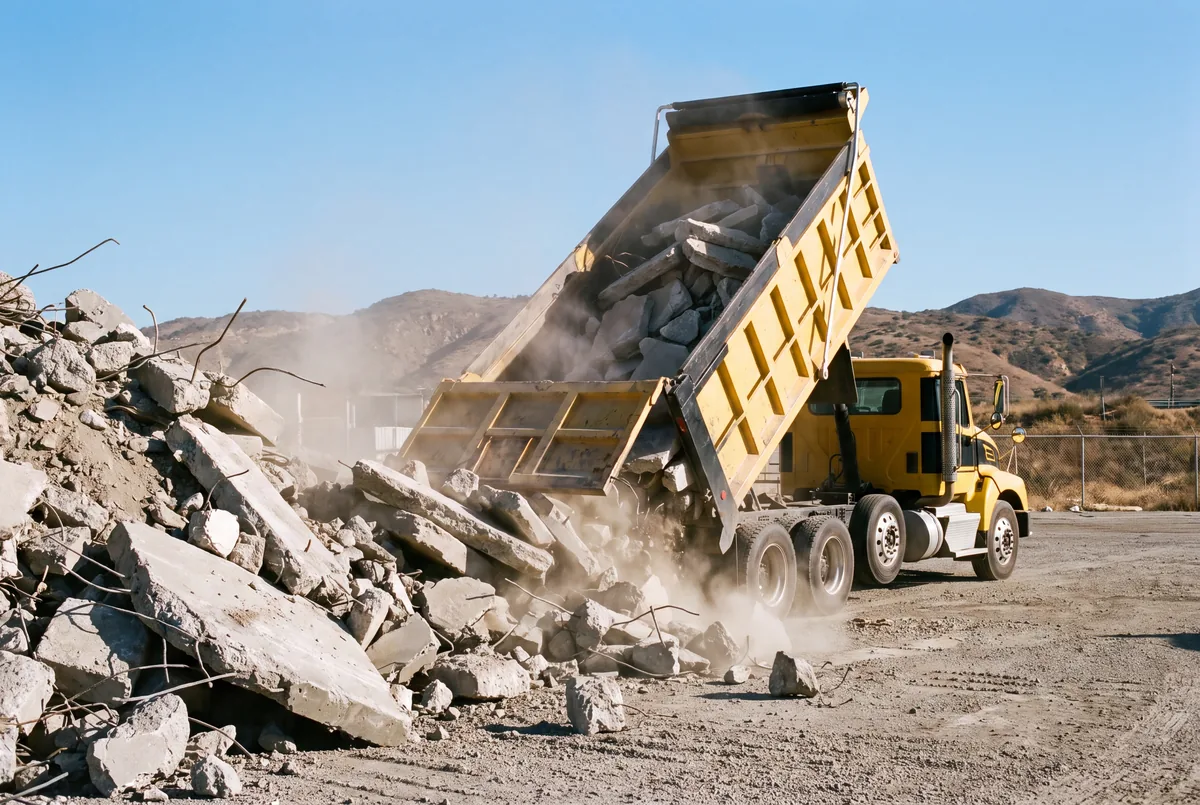
The truck tips, the rubble slides off, the gate crew waves you on. That is where most people’s mental picture of concrete recycling ends. The interesting part happens after you leave. Here is the full path, from a pile of broken slab to a load of finished base material rolling out the same gate in someone else’s truck.
Step 1: Inspection and sorting
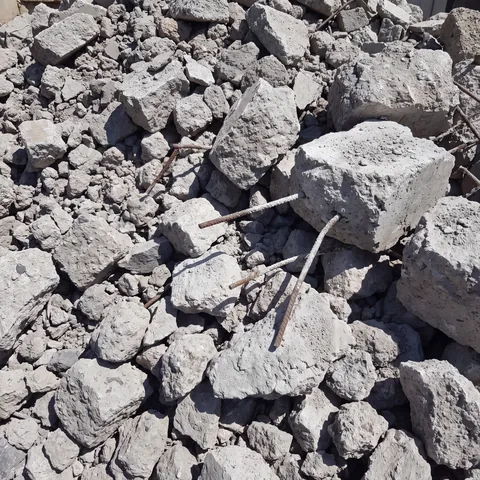
Every load is looked at as it arrives. Clean concrete goes to the concrete stockpile; clean asphalt goes to the asphalt stockpile. If a load has stray trash, wire, or oversize pieces, those are pulled out before the material joins the pile — and that handling is what the surcharge covers. Keeping the incoming stockpiles clean is the single most important thing a yard does, because everything downstream depends on it.
Step 2: Breaking down the big stuff
Pieces that arrive near the size limit are fed straight to the crusher. Anything larger is broken down first, usually with an excavator fitted with a hydraulic breaker or a shear. Long rebar is cut and pulled. This is slow, equipment-heavy work, which is why yards ask you to do it on the job site where it is faster and cheaper.
Step 3: Crushing
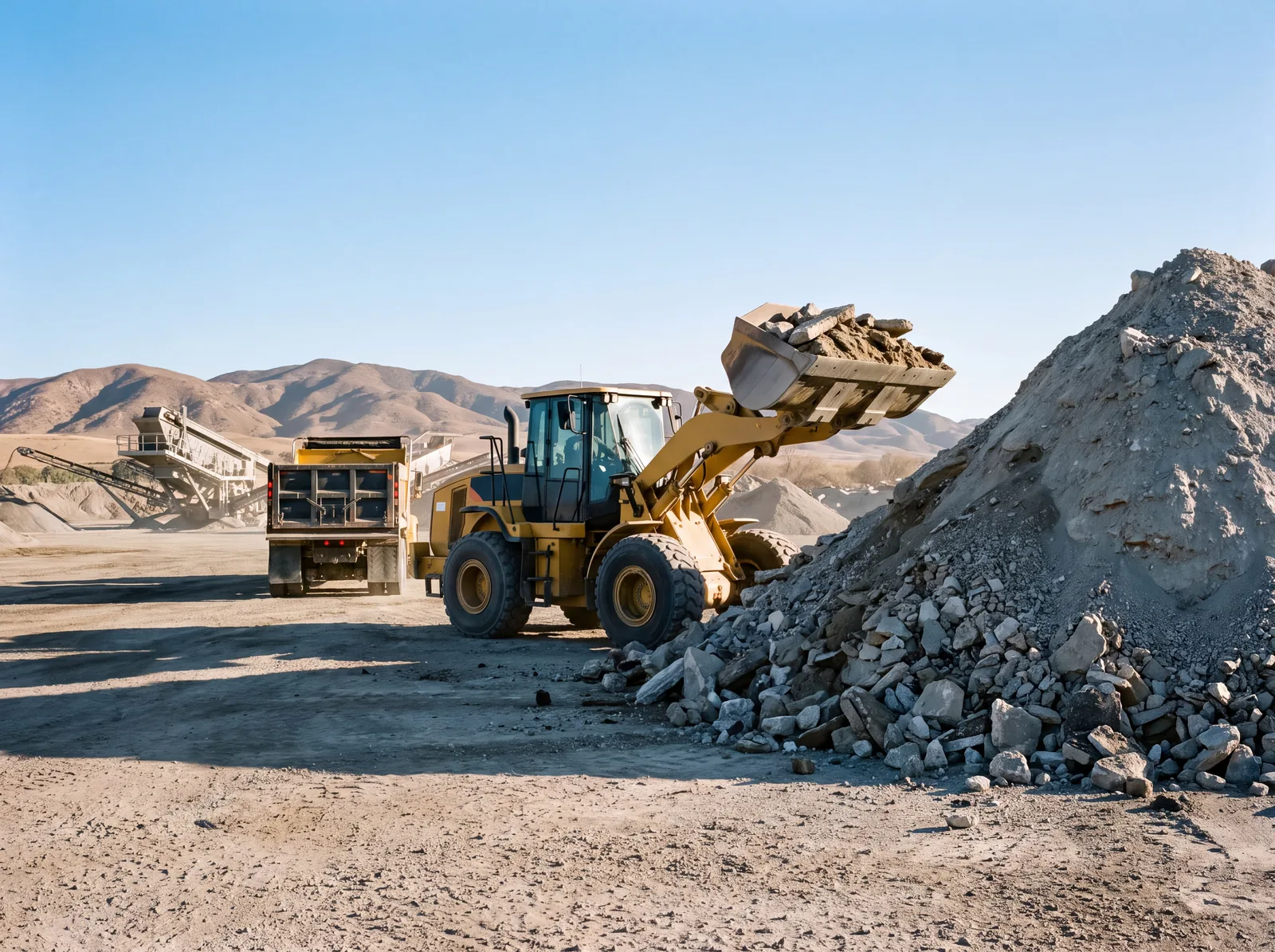
A loader feeds the stockpile into a crusher — typically a jaw crusher for the first pass, which squeezes the rubble between a fixed plate and a moving plate until it fractures, and sometimes an impact crusher for a second pass that produces a more uniform, angular product. Magnets over the discharge belt pull out the remaining rebar and wire, which is sold as scrap steel.
Asphalt goes through the same machinery but is often run separately, because the binder in it behaves differently from cement-bound concrete and the finished products serve different purposes.
Step 4: Screening
Crushed material is run over vibrating screens that sort it by size. Oversize pieces go back to the crusher. The rest is separated into products: a coarse aggregate, a graded base that mixes coarse pieces with fines in a specific proportion, and sometimes a fine material used as fill. The graded base is the big seller — that blend of sizes is what lets it compact into a dense, stable layer.
Step 5: Stockpiling and quality
Finished products are stockpiled by type and size. A good yard keeps an eye on the gradation — the mix of particle sizes — so that a load bought in March behaves the same as one bought in September. Contractors working to a spec will sometimes ask for a sieve analysis; many public agencies allow recycled concrete in their standard base specifications as long as the gradation is right.
Step 6: Back out the gate
Then a truck pulls in, a loader fills it with base material, and the cycle closes. The slab that was a patio in Bonita last month becomes the compacted layer under a driveway in Eastlake next month. Nothing went to the landfill, no quarry was dug for new rock, and both the dumper and the buyer paid less than they would have otherwise.