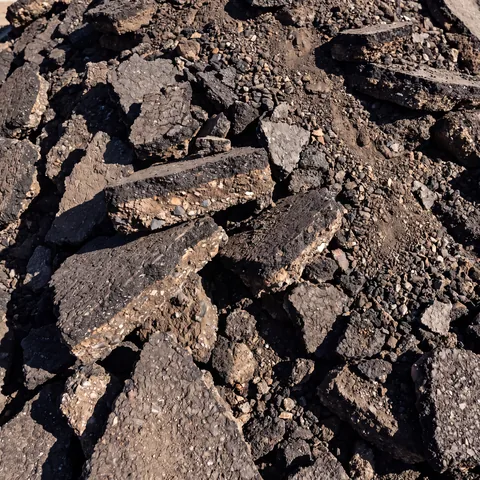
When a road or parking lot is resurfaced, the top layer is ground off by a milling machine before the new asphalt goes down. The ground-up material — asphalt millings, grindings, or reclaimed asphalt pavement, depending on who you ask — is one of the most useful recycled products in construction. It is also one of the most misused, because people treat it like gravel and then wonder why it does not perform like pavement.
What makes millings different from gravel
Gravel is rock. Millings are rock coated in asphalt binder, the same petroleum-based glue that holds a road together. That binder is dormant at normal temperatures, but it softens with heat and pressure. Spread millings on a warm day, run a roller over them, and the particles knit together into a surface that is firm, sheds water, and does not kick up dust. Over a few weeks of summer sun and traffic they keep tightening. Spread them in January without compaction and they sit there as loose black gravel indefinitely.
Where millings work well
- Driveways, especially long rural ones where hot-mix paving is out of budget.
- Parking and equipment yards, where dust control and a surface that does not rut under tires matter.
- Farm, ranch, and vineyard roads.
- Base under a new asphalt overlay.
- Temporary construction access roads and laydown areas.
- Paths and walkways where a dark, firm, low-maintenance surface is wanted.
Where they are the wrong choice: directly under a concrete slab or pavers, where the slight give of a bound asphalt layer is not what you want, and in drainage applications where water needs to pass through freely.
How to install them
- 1Prepare the ground. Remove vegetation and topsoil, grade for drainage, and compact the subgrade. Millings will not fix a soft base.
- 2Spread in lifts. Lay the material about two to three inches deep at a time. A finished driveway is often four to six inches total, built in two lifts.
- 3Compact each lift. Use a vibratory plate compactor for small areas or a drum roller for anything bigger. Work from the edges toward the center.
- 4Pick a warm day. Millings compact dramatically better when the material is warm. In San Diego that is most of the year, but a hot afternoon beats a cool morning.
- 5Water lightly if the material is very dry, then compact again. A little moisture helps the fines settle.
- 6Let traffic finish the job. Slow, repeated vehicle passes over the first few weeks tighten the surface further.
How much to order
Estimate by volume: length × width × depth (in feet), divided by 27, gives cubic yards. A 12-by-60-foot driveway at four inches deep is 12 × 60 × 0.33 ÷ 27, or roughly 9 cubic yards before compaction. Order a little extra, because millings compact down noticeably, and because the yard sells by the loaded truck, not the theoretical yard.